

Yes, you can get microblading for oily skin, but your skin type can change how the finished brows heal and how much maintenance they need. People with oilier skin may notice that fine microbladed strokes heal softer, lose definition sooner, or require earlier maintenance than the same technique on drier skin.
That does not mean oily skin automatically makes you a bad candidate. What matters is how oily the skin around your eyebrows actually is, your pore size, the brow look you want, your aftercare habits, and whether the artist knows how to adapt the treatment to your skin.
If you are considering microblading in Las Vegas, those are the questions worth answering before choosing a brow shape or pigment color.
Does microblading work on oily skin?
Yes, it can. The more useful question is whether traditional hair-stroke microblading is likely to heal in the way you expect.
Microblading creates very fine pigment strokes designed to resemble eyebrow hairs. On oilier skin, brow artists commonly see those strokes heal somewhat softer or less sharply defined than they do on dry skin.
That can still produce an attractive result, especially when the skin is only mildly or moderately oily. Someone with very oily skin and noticeably larger pores around the brows may need a different approach or different expectations.
Microblading may make sense when:
- Your brow area is only mildly or moderately oily.
- Your pores around the eyebrows are relatively small.
- You specifically want visible hair-like strokes.
- You understand that maintenance may be needed sooner.
- You are willing to follow the artist’s healing instructions closely.
Think more carefully before booking when:
- Your forehead and brow area become very oily shortly after cleansing.
- Your pores are visibly large around the eyebrows.
- Previous cosmetic pigment has faded unusually quickly.
- Your main goal is a sharply defined, filled-in brow rather than individual strokes.
- You want the lowest-maintenance permanent brow option possible.
In short: Oily skin microblading is possible, but the oilier and more porous the brow area is, the less predictable extremely fine hair strokes may be.
Why does oily skin affect microblading?
Skin naturally produces an oily substance called sebum. Someone with oily skin produces more of it, particularly in areas such as the forehead and T-zone.
For microblading, artists pay attention to oil production and pore size because both can influence how fine strokes look once the skin has completely healed. Industry guidance consistently notes that very oily skin tends to produce softer-looking healed strokes than dry skin.
This matters because the brows you see immediately after an appointment are not the final result.
Fresh microblading normally appears darker and more defined. The more meaningful test is how the pigment settles after healing.
Three differences oily-skin clients should expect
- Hair strokes may heal softer
Individual strokes may not remain as razor-sharp as they appeared immediately after treatment.
- Pigment retention may be less predictable
Some areas may retain pigment differently from others, making the follow-up appointment especially useful for evaluating the healed result.
- Maintenance may be more frequent
Oily-skin clients sometimes return for color refreshing sooner than clients whose skin retains fine strokes particularly well. Exactly when that happens varies from person to person.
There is no responsible way to promise that your brows will last an exact number of months based only on whether your face is “oily.”
In short: Skin type influences microblading pigment retention, but it is only one part of the outcome. Technique, pigment, sun exposure, skincare, healing, and individual skin behavior also matter. Research on microblading notes that sun exposure and exfoliating skincare treatments can contribute to pigment fading.
How oily is too oily for microblading?
A common mistake is deciding based on the cheeks or nose rather than the skin where the procedure will actually be performed.
Your artist needs to assess the eyebrow area.
Someone may have an oily nose but relatively balanced skin around the eyebrows. Another person may have significant oil production across the entire forehead and brow region.
Before your consultation, notice what happens to your skin during a normal day.
Signs your brow area may be mildly oily
- Some shine develops later in the day.
- Makeup generally stays in place around your eyebrows.
- Pores around the brows are not particularly noticeable.
- Your eyebrow area does not feel greasy soon after cleansing.
Signs it may be very oily
- Shine returns quickly after washing your face.
- Brow makeup breaks down rapidly.
- You frequently blot your forehead and eyebrow area.
- Pores around your brows are clearly visible.
Do not treat this as a medical skin test. It is simply useful information to bring to your brow appointment.
Practical tip: Go to your consultation with your normal skin rather than trying to make it unusually matte that day. Your artist needs an accurate picture of how your skin behaves.
Microblading vs other brow options for oily skin
The right service depends on both your skin and the finished look you want.
Brow option | Finished look | Oily-skin consideration | Maintenance |
Microblading | Individual hair-like strokes | Very fine strokes can heal softer on oilier skin | May require periodic refreshing |
Powder brows | Softly filled or makeup-style brow | Often considered when traditional strokes are not ideal for very oily skin | Varies by skin and technique |
Combo brows | Hair strokes plus shaded fullness | Can combine natural-looking fronts with more definition | Varies |
Eyebrow tinting | Darkens existing brow hairs | Skin oil does not create the same permanent-pigment commitment | Temporary |
Eyebrow threading | Cleans and reshapes natural brow hair | Suitable when your main problem is shape rather than missing brow hair | Regular grooming |
Permanent powder and combination techniques are frequently discussed as alternatives when extremely oily skin does not retain delicate microbladed strokes as cleanly.
That does not automatically make one technique superior.
If you have plenty of natural eyebrow hair but dislike the shape, eyebrow threading may solve the problem without cosmetic tattooing. If the hairs are present but too light, eyebrow tinting may give you enough definition without committing to pigment placed in the skin.
For someone with sparse areas who wants individual simulated hairs, eyebrow microblading may still be worth discussing.
In short: Choose based on the problem you are trying to fix, not simply which brow treatment is popular.
How long does microblading last on oily skin?
There is no reliable expiration date that applies to everyone.
You will see articles giving fixed ranges for oily, normal, and dry skin. Those estimates can be useful for understanding the general pattern, but they should not be treated as promises.
Dermatology literature describes microblading as a form of cosmetic micropigmentation that fades over time, and the American Academy of Dermatology notes that results are not permanent.
Your personal maintenance schedule can be affected by:
- How oily your brow area is
- Pore size and skin characteristics
- How your first treatment heals
- Sun exposure
- Exfoliating products near the brows
- Retinoids and other skin-renewing products
- Picking or disturbing healing skin
- The technique and pigment used
- Your body’s individual response to pigment
Instead of asking an artist, “Will this last exactly one year?” ask:
“Based on my skin and the healed work you have seen from similar clients, what maintenance should I realistically expect?”
That question is much harder to answer with sales talk.
What should you expect from microblading healing with oily skin?
Your eyebrows will not look the same on appointment day, one week later, and once they have fully settled.
That is normal for cosmetic tattooing.
During microblading healing, the brows may initially appear darker and sharper. As the skin recovers, the appearance can soften, and some areas may seem lighter than others.
A scheduled follow-up lets the artist see how your skin actually retained the pigment rather than guessing beforehand.
For oily skin, that healed assessment matters even more because some clients retain fine strokes better than others.
Do not judge the result too early.
One first-person account among the research material described substantial fading before a follow-up, followed by adjustments based on how the original strokes had healed. That illustrates why an experienced artist evaluates healed results before simply adding more pigment.
Avoid trying to “fix” light areas yourself with aggressive skincare, picking, scratching, or unauthorized products.
Follow the instructions given for your specific procedure.
In short: The result that matters is your healed brow, not the very dark and precise brow you see when you first leave the appointment.
Microblading aftercare for oily skin
Good microblading aftercare for oily skin is not about trying to eliminate your natural oil production.
It is about allowing the treated skin to heal without unnecessary irritation, moisture, friction, or products that interfere with your artist’s instructions.
Aftercare protocols differ between artists and techniques, so follow the instructions provided by the professional who performed your procedure rather than mixing advice from several websites.
Common precautions may include temporarily avoiding:
- Picking, peeling, or scratching the treated skin
- Brow makeup during the initial healing period
- Swimming or soaking the brows
- Heavy sweating while the area is healing
- Strong exfoliating products around the treated area
- Retinoids or acids near the brows unless cleared by your provider
- Prolonged direct sun exposure
Once the area has healed, sun protection matters because repeated UV exposure can contribute to pigment color changes and fading.
Do not improvise with heavy ointments.
More product is not necessarily better for oily skin.
Use only the cleanser, ointment, balm, or healing method your artist recommends. Applying extra products because the brows “look dry” can conflict with the intended healing protocol.
In short: Follow one aftercare plan consistently. Your artist’s instructions should take priority over a generic online routine.
How to choose a microblading artist in Las Vegas
When searching for microblading Las Vegas services, beautiful before-and-after photos are useful, but they should not be your only screening tool.
Look closely at healed work.
Fresh brows naturally look darker, cleaner, and more dramatic than healed pigment. Ask whether the artist can show healed results from clients whose skin characteristics resemble yours.
Ask these questions before booking.
- Have you worked with oily skin around the brow area?
- How could my skin type change the healed result?
- Can I see healed examples rather than only same-day photos?
- Would you change the stroke spacing or technique for my skin?
- What should I realistically expect from the first follow-up?
- What aftercare instructions will I receive?
- If traditional microblading is not suited to my skin, what would you recommend instead?
There is also a Las Vegas-specific credential check worth making.
The Southern Nevada Health District classifies permanent makeup as body art. Artists providing these services in Clark County are required to have either a Body Art Card or Microblading Card, depending on the work they perform.
That is far more useful than relying on phrases such as “certified artist” without knowing what the certification represents.
When might microblading not be the right choice?
Being eligible for a beauty treatment and being a good candidate for the result you want are two different things.
If your skin is extremely oily, your pores are pronounced around the brow area, or you expect every hair stroke to remain sharply separated for a long time, traditional microblading may not match those expectations.
There are other reasons to delay a cosmetic tattoo as well.
If the skin around your brows is irritated, infected, actively breaking out, or affected by a dermatologic condition, get appropriate professional advice before proceeding. The American Academy of Dermatology also recommends speaking with a dermatologist when considering microblading, since complications such as misplaced pigment and color changes can occur.
You should also tell your provider about prescription skincare products and recent skin treatments.
And if you simply are not comfortable with permanent makeup yet, there is no reason to force the decision.
At Eyebrows R Us, clients interested in brow definition can also consider services such as eyebrow threading, shaping, and eyebrow tinting while deciding whether microblading is the right longer-term option. The business promotes threading, tinting, microblading, eyebrow tattoo, and facial threading services in the Las Vegas area.
In short: A good brow decision sometimes means choosing not to microblade yet.
FAQ about microblading for oily skin
Yes. In many cases, you can, but oilier skin may cause very fine hair strokes to heal softer and may change how frequently maintenance is needed.
An artist should evaluate the skin around your brows rather than making a recommendation from your general skin type alone.
Brow professionals commonly report that oily-skin clients can experience faster or less predictable pigment retention than dry-skin clients.
Skincare, sun exposure, technique, aftercare, and individual healing also affect fading.
It depends on the degree of oiliness and the result you want.
Someone with extremely oily, large-pored skin who wants a very defined brow may want to discuss other permanent brow techniques before choosing traditional hair-stroke microblading.
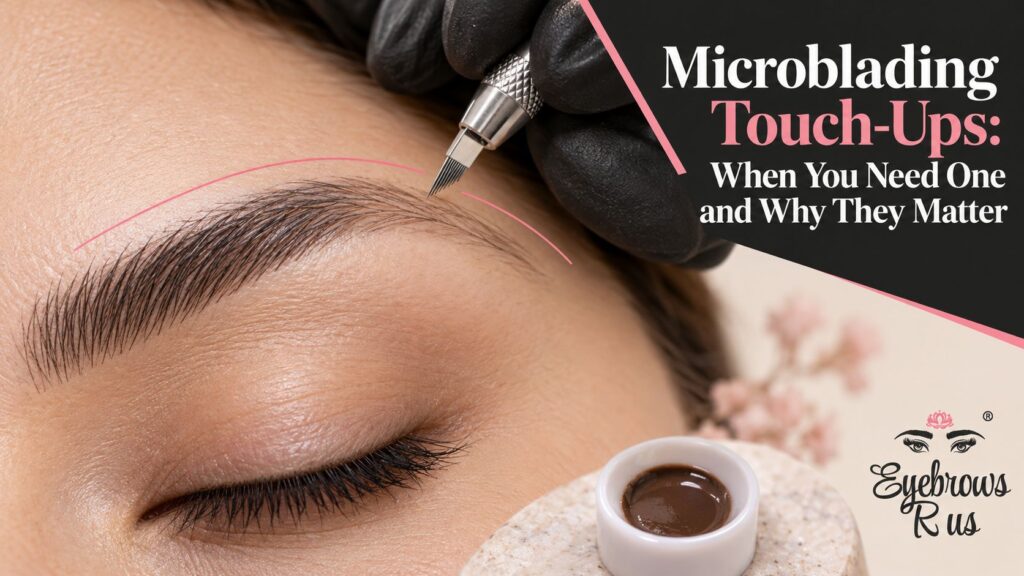
A microblading touch-up or follow-up is commonly part of the process because it gives the artist a chance to evaluate healed pigment and refine areas that need attention.
Do not assume needing a follow-up means the original treatment failed.
Powder brows for oily skin are often considered when very fine microbladed strokes may not heal distinctly enough. Powder techniques create a shaded effect instead of relying exclusively on individual hair strokes.
Whether that appearance suits you is a separate question.
Retinoids and exfoliating skincare products can affect cosmetic pigment and the surrounding skin. Dermatology literature recommends protecting microbladed areas from retinol and exfoliating treatments.
Ask your treating professional when and where you can safely restart your normal skincare routine.
If you are considering eyebrow microblading Las Vegas services, Eyebrows R Us offers microblading along with eyebrow threading, tinting, facial threading, and other brow services in the Las Vegas area.
Call or book an appointment to discuss your brow goals and whether microblading fits your skin and preferred finished look.
Is microblading for oily skin worth it?
Microblading for oily skin can be worth considering when you want natural-looking hair strokes and understand that oily skin may make the healed result softer or require more maintenance.
The mistake is assuming every oily-skin client will get the same result.
Look at the oiliness and pore size around your actual eyebrow area, decide whether you want hair strokes or a filled-in effect, review healed work, ask about maintenance, and choose a properly credentialed provider.
If you are in Las Vegas and want help deciding what makes sense for your brows, contact Eyebrows R Us. Ask about microblading, or consider eyebrow threading and tinting if you want to shape and define your brows without making the same commitment.
Call now, walk in, or book an appointment with Eyebrows R Us to discuss your brow goals and find the right approach for your skin.
 ICONIER Digital Agency